
What I Brought Home from Financial Brand Forum 2026 (Besides a Full Notebook)
Jeffrey Staw - April 22, 2026 - Curated Thoughts of the 2026 Financial Brand Forum
I came back from Financial Brand Forum 2026 with a full notebook, a head full of ideas, and one story I keep telling anyone who will listen - more on that in a moment. obvious
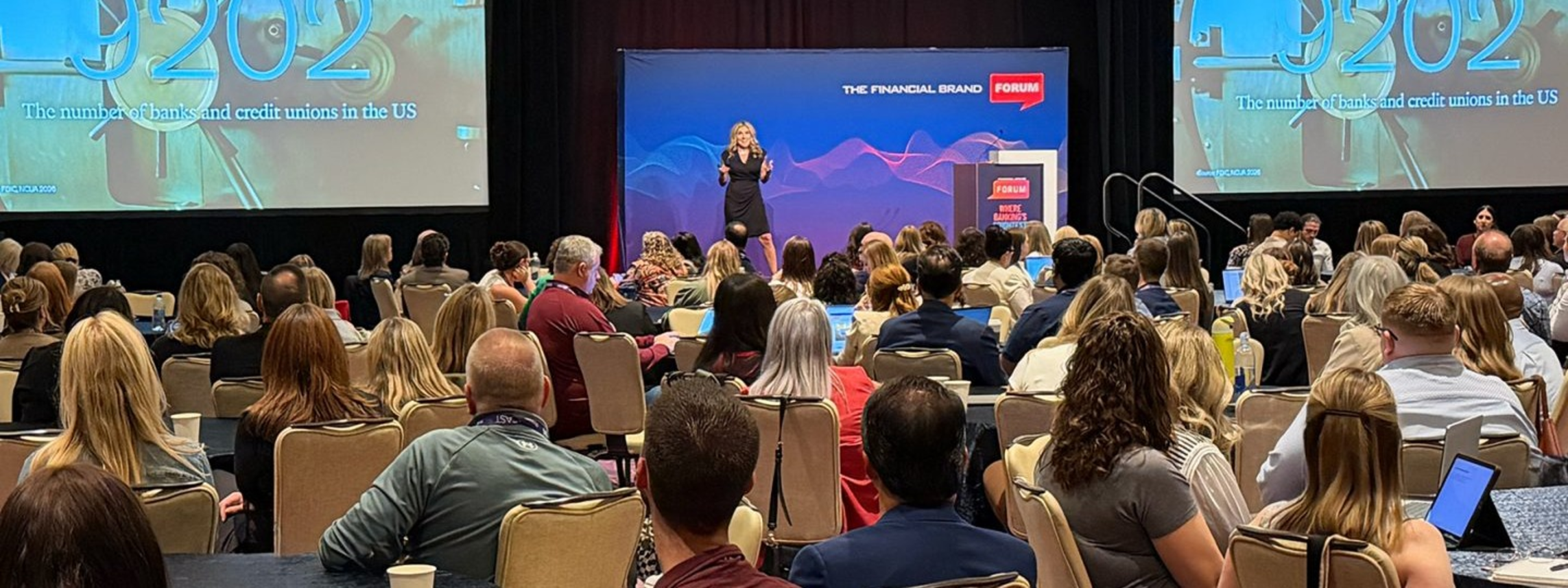
The Forum ran April 14th–16th at the Aria in Las Vegas. If you couldn't make it this year, I want to give you something more useful than a highlights reel. I want to give you the feeling of being in the room and my view of some of the ideas worth carrying back to your own credit union
Over 2,000 banking and credit union leaders filled the Aria's incredibly vast conference spaces for three packed days: general sessions, breakout tracks, Forum X Talks, Lunch & Learns, and evenings – let’s just say those stay in Vegas!
By most accounts - my own included (as this was my first FBF) - this was the best Forum to date. The conversations were spot on with urgency and an aggressive vision for the future. And there was a recurring undercurrent of member service and excellence.
The Room Was Done Talking About AI. Now It Wants Action.
Jim Marous and Ron Shevlin opened Monday afternoon with Pardon the Interruption, modeled after the ESPN debate show, a four-minute timer per topic. This format has gotten popular as these guys have gotten better at it over the years; it was standing room for this session.
Ron Shevlin, Chief Research Officer at Cornerstone Advisors, made an immediate point: we need to stop using "AI" as a catch-all. There's a meaningful difference between machine learning, conversational AI, generative AI, and agentic AI - systems that take autonomous action on behalf of a user are different than those that simply give you answers to questions. Treating them as interchangeable muddies every strategic conversation that follows.
Jim Marous, co-publisher of The Financial Brand, pressed the hard truth: we talk about AI constantly and deploy it rarely. Move it from back-office efficiency projects into customer-facing improvement. The uncomfortable question he left in the room: what agents are your members already using on their own.
As a credit union, our members' lives are increasingly managed by tools we didn't build. If we're not at the table for those interactions, we're not at the table.
The real AI opportunity isn't headcount reduction - that framing is reductive and even potentially damaging to the all-important credit union culture. It's friction elimination: fewer handoffs, less rote work, more time for the interactions that require judgment and humanity.
The way I look at it – humans doing uniquely human tasks, everything else is automated.
That Doesn't Feel Like Marketing: Mike Cessario and Liquid Death
The session I least expected to get something from ended up being one I'm still thinking about. Mike Cessario is the founder of Liquid Death, canned mountain water, heavy metal skull & bones branding, tagline "Murder Your Thirst," currently valued at $1.4 billion with $333 million in revenue in over 113,000 retail locations. Before that, he was a creative director at Netflix. He is not an obvious speaker for a financial services conference. And yet:
His origin & aha moment: at a music festival, he noticed band members drinking water from Monster Energy cans, not because they liked Monster, but because they were under sponsorship and didn't want to be seen with a plain bottle. Perception was more powerful than the product. That observation became a company. Before a single can of water existed, Cessario Photoshopped a mockup, borrowed a camera for $500, shot a weekend commercial in a friend's empty office, and spent $5,000 on Facebook ads to prove there was demand. He started not with the product, but with the question of whether anyone would care. Most institutions never ask that question about themselves. As credit unions, we just assume sometimes, right?
His core argument deserves attention: the one thing Coke and Pepsi cannot replicate with hundreds of millions of dollars is authenticity. You cannot manufacture it with money. It either lives in the brand's DNA or it doesn't. He also argued we're returning to the 1950s model - when P&G hired drama writers to produce soap operas (I learned where those shows came from) and attached their brand to entertainment people actually sought out. His test for any piece of content: "Would I personally share this if it weren't my brand?" If the honest answer is no, the content isn't ready. Marketing should be treated like a product - test, measure, iterate, and stop funding things that don't move people.
What stopped me was when he turned the lens directly on financial services. Banking and credit unions are, he argued, the perfect candidate for creative disruption. The category is almost entirely absent of interesting brand work. Any institution willing to invest in culture and psychology at the brand level, rather than leading with rate sheets (what the industry has always done?), could own their credit union experience narrative as a tool for massive growth.
Branches, Deposits, and the $14 Trillion Wealth Transfer
44% of institutions are currently expanding their branch investment. Branches aren't dead, but the question has evolved from "physical or digital" to "do you have a strategic narrative for why you're building?" A branch can be a brand hub, a trust venue, a place where complexity gets resolved in a way no chat interface can. The FBF consensus onion says you cannot fund aggressive branch expansion and robust digital development simultaneously at scale. That's not a technology limitation - it's a capital allocation reality. I say – MAYBE correct…
There was a lot of focus on branches and their meaning to the brand and the service model. Some commentary seemed spot on, but also, some seemed like it was generated by those who really wanted branches to stick around for reasons they could not articulate, even in the face of reduced use and country wide expansion that was based on digital growth. If you have a reason for a branch – great – if not – not!
Ron Shevlin's framing of "deposit displacement" stuck with me. Between 2020 and 2025, an estimated $3 trillion moved out of banks and credit unions into fintech platforms, neobanks, stablecoins, Cash App, Chime and, closed-loop systems like EZPass and Starbucks. What does the term “Core Deposit” even mean anymore?
The session that put the longest-term challenge in sharpest focus came from SLH Group. Roughly $1.4 trillion is transferring between generations annually, with $14 trillion expected by 2035. The top 2% of households control 44% of that wealth. But here's what most institutions are missing: 70% of inherited wealth will ultimately be controlled by women, largely due to longer life expectancy - OPPORTUNITY.
A single data point captured the room’s false confidence: 88% of wealth management customers report being satisfied with their current advisor. But 47% of those same satisfied customers are actively looking to switch.
Growth doesn't come from better apps; it comes from how members feel at the moments that matter.
One presenter described her own daughter opening an education savings account at a local bank rather than through the family's long-standing wealth advisor - simply because the advisor had never had a conversation with her. The lesson is simple: by the time a member is gone, it's too late to build loyalty with the next generation. Engage them now. On personalization: It’s no longer a technology problem. Generative AI makes real personalization technically achievable. The blockers are data hygiene and leadership. Every institution in that room says member experience is the number one priority, yet investment in data consistently ranks low in actual budget allocation.
The Story I Keep Telling: Will Guidara and Unreasonable Hospitality
Tuesday's keynote was the highlight of the conference – period (do you need another period when you say that?).
Will Guidara built Eleven Madison Park into the number one restaurant in the world. His talk was one of the most direct and transferable things I've heard at any industry event in years. He closed his restaurant, brought in every staff member, dishwashers to owners, and spent an entire day mapping every guest touchpoint. Teams started with around 30 and surfaced over 130 by the end of the day.
The insight wasn't the volume; it was that the overlooked touchpoints, the ones where competitors do nothing, are where small, unexpected gestures have the greatest emotional impact – unexpected delight – have the greatest emotional impact.
The story that stopped the room was the hot dog. A group of European food tourists mentioned offhandedly that they'd never managed to get a real New York City hot dog. Guidara’s team overheard the conversation and slipped out, bought one from a street cart, had it plated beautifully in the kitchen, and served it. These guests had just finished one of the finest meals in the world. Their reaction to a two-dollar hot dog was stronger than anything else that night. His lessons: be fully present with the person in front of you. Don't take yourself too seriously - serving a street hot dog at a Michelin three-star restaurant is completely off-brand, and that's the point (his brand is delight not food). And one size fits one: hospitality is the act of making one specific person feel genuinely seen, not a category strategy.
He described a role at the restaurant with zero operational responsibilities — a "Dream Weaver" with resources and a mandate to bring unexpected ideas to life. Sledding in the park after a meal. A couple who married at City Hall receive an impromptu first dance. None of these were on the menu, none of them expensive. All of them are why guests came back.
His call to action: within a month, identify one overlooked touchpoint and make it more worthy of the trust your members place in you. Start there.
What FBI Hostage Negotiation Means to Difficult Member Conversations
Wednesday's keynote belonged to Chris Voss, and I'll admit I walked in skeptical about how 24 years of FBI hostage negotiation would translate to banking. By the end, I was writing faster than I had all week.
Voss was the FBI's lead international hostage negotiator, and a certifiable bad-ass. He described securing the release of Jeff Schilling, taken hostage with a significant monetary demand, without putting any money on the table. His approach: create a "breakthrough environment," stay collaborative, let the conversation unfold until the captor's grip loosened enough that the hostage could simply walk away.
The principle underneath that outcome is transferable to every high-stakes conversation: the person across from you will not move until they feel heard. You cannot problem-solve before you've made someone feel understood – and legitimately understood. There was a lot of Dale Carnegie thinking going on here – true relationships versus fake alignment.
His framework is Tactical Empathy, not soft, but smart. It's about accurately articulating the other person's perspective back to them so they feel genuinely understood before you ask for anything. He distinguishes "yes" from "that's right." When someone says "yes," they may just be moving the conversation forward. When they say "that's right," they feel accurately heard — and real dialogue becomes possible. Chris also reframes 'No' as a tool rather than a wall. When someone says no, they feel in control - and that safety is what opens the door to real negotiation.
I kept coming back to loan denials, inflamed member complaints, vendor negotiations, regulatory conversations. The instinct in everyone is to explain, justify, defend. Voss's point is that none of that works until the other person feels heard first. For a credit union whose identity is built around being more human than a big bank, this isn't a negotiation tactic. It's an operational philosophy.
Financial Education as Competitive Moat: Kelly Ball and the TikTok Gap
Kelly Ball, CEO of Pathfinders and an Assistant Professor at Notre Dame, opened with a data point that should concern anyone in this industry: when younger consumers have a financial question, they go to TikTok, YouTube, or Reddit first. Only 17% of young people report receiving any financial education from their financial institution. Meanwhile, 28.5% of Americans seeking financial advice now turn to social media.
Ball's argument is that we can reclaim this space, but not with the standard playbook. What actually works is consistent cadence, recognizable internal voices, and content designed for social consumption.
Something like a weekly "Financial Tip Friday": not flashy, not production-heavy, but predictable. The credibility signal online is regularity. Sporadic posting, however polished, makes an institution easy to overlook. And success here shouldn't be measured by last-click conversions additional metrics are branded search growth, engagement quality, and whether your institution is becoming part of how people think about money. His closing line was simple: "Start small, be consistent, and use your own voice. That is how you win back attention and trust."
For credit unions, this hits our core purpose. Our members face real financial decisions across demanding careers, retirement planning, shift differential income, and building wealth across a life that comes with daily pressures. If the next generation of members learns to think about money from a TikTok influencer instead of from us, we've missed one of the most fundamental ways we can serve them. Financial education done consistently isn't just the right thing to do, it's one of the few channels left where a credit union's authentic voice has a genuine advantage over big banks.
Get this – in another unrelated session, someone stood up and said – “I’m 35 years old and I wouldn’t bank with anyone who didn’t have their executive team on TikTok.” Make of that what you will – but it is data point worth pondering…In Closing
I've been in financial services long enough to attend a lot of conferences. What made this one great wasn't the production value or the Las Vegas backdrop (although I did have some fabulous Chinese food). It was the quality of the discomfort. People were pushed on assumptions they'd held comfortably for years - AI deployment, brand building, whether they'll still have relationships with the next generation when the wealth transfer arrives, and how to make a member feel heard.
If you made it to the Forum this year, I'd love to compare notes. If you didn't, I hope this gives you something to take into your next planning conversation.
Check out their website, FBF has made a ton of their resources available:
https://financialbrandforum.com/digital-toolbox/